

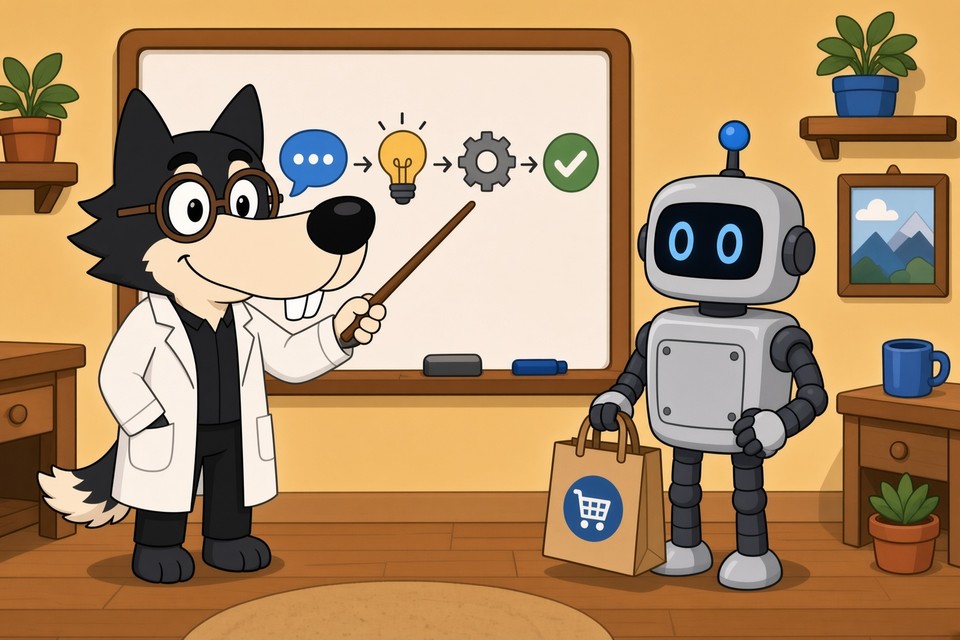
You’ve probably heard “agentic AI” a lot this year. News headlines. LinkedIn posts. Someone at work who assumes you already know what it means.
You don’t have to. Here’s the plain version.
The AI you already know
Most people have used a chatbot — ChatGPT, Claude, or something similar. You ask a question. It answers. Then it waits.
That kind of AI is good at producing information. It can summarise a document, draft an email, or explain a concept. But it stops there. It never actually sends the email. It never books the flight. It hands you the text and waits for you to do the next step.
What “agentic” adds
Agentic AI can take real actions, not just describe them.
You say: “Book me a flight to Sydney next Friday.”
- Old AI: “Here’s how you could do that.” Then it stops.
- Agentic AI: Searches flights, picks a sensible option, fills in the details, pays, and sends you the confirmation.
The big change isn’t raw intelligence. It’s autonomy — carrying a multi-step task through from start to finish, checking its own progress, without you doing each step by hand.

Wolfie’s tip: If it only answers questions, it’s the old kind. If it can finish the errand for you, that’s agentic.
Why the word “agentic”?
It comes from agent — someone who acts for you.
A travel agent doesn’t only list flights; they book the trip. A real estate agent doesn’t only describe houses; they help close the deal. Agentic AI is the same idea for software: from advisor to doer.
Side by side
| Traditional AI | Agentic AI |
|---|---|
| Answers a question | Finishes a multi-step task |
| Produces text or suggestions | Takes real actions (book, pay, send) |
| You do each next step | It does the steps in sequence |
| “Here’s what you should do” | “I did it — here’s the result” |
Why people are excited — and careful
Excited: It can take whole chunks of admin off your plate — inbox and calendar, basic support tickets, invoices, research.
Careful: An AI that can act can also act wrong. Wrong flight. Wrong email. Money spent by mistake.
That’s why most agentic tools today still pause before anything high-stakes. They ask for your confirmation before spending money, sending something public, or changing important data. Capable assistant, not unsupervised operator.
That’s the whole idea. The rest is detail.